

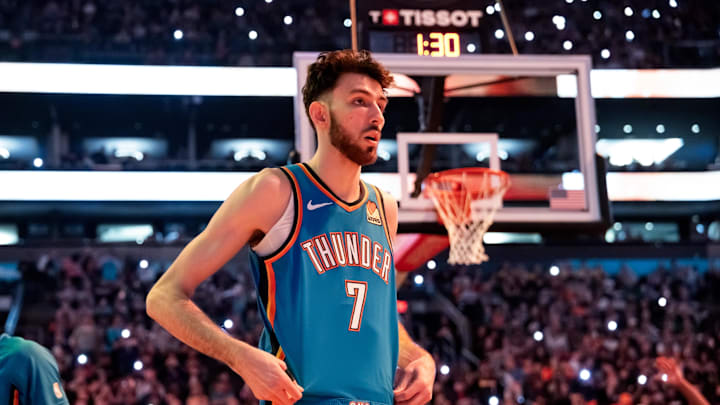
Chet Holmgren is as relaxed as you would expect a 23 year-old to be. His breezy disposition doesn't stem from a life free of major responsibilities, though, as you may be prone to assume of someone his age. Quite the opposite. Not even four years into his NBA tenure, Holmgren can already check off two work successes that most NBA players will fruitlessly hunt for their entire career: an All-Star appearance and a championship ring. Holmgren is presumed to add an All-Defensive selection (the first of many) at season's end, too.
That on-court success has seemed to bring a sense of equanimity to Holmgren, which shone through when I spoke with the Oklahoma City Thunder forward via video call late last month. But don't mistake that for complacency. Despite reaching a mountaintop few basketball players do — and possessing the awareness that winning a title often includes a swift fall from greatness — Holmgren seems to understand the balancing act required to persist (and improve) during the grind of a title season's encore.
"Human nature changes a lot," Holmgren told me. "You have a different relationship with winning; a championship changes that. But I also feel like playing enough games and getting enough games under your belt changes that as well. My third or fourth or fifth game in the NBA, every game felt like the Super Bowl because I had played five games. And then you go through Game 7s in the playoffs, Game 7s in the Finals, play all these super high-stakes games — and now it's, 'Okay. How do you make sure that you're at your best for game 22 of the regular season, and still chasing improvement without attaching too much emotion to the game?'"
Chasing improvement is as much a joint venture as an individual endeavor, and Holmgren has the privilege of playing for an organization that is simply better than others at that chase. From the hawk eye of GM Sam Presti to the no-longer-secret aptitude of head coach Mark Daigneault, the Thunder franchise has rightfully earned its label as the best talent development program in the league; the credit for that is split between coach and player alike, Holmgren said.
"Mark gets a ton of credit for the basketball culture [that he's built] as a team. There's never any jealousy of like, 'Oh, this person's having a night. I need to match up to that, so I don't get outshined.' It's always, 'If the team shines, we all shine,'" Chet said. "If somebody's having a night, we're trying to feed them and keep that going, whatever it is. Mark does a great job of making sure that no matter who's out there on the floor, we're maximizing everybody together...He finds out how to maximize the different strengths of everybody on the floor, no matter who it is."

The Thunder aren't turning bad players into good players. They are, however, finding good players where other teams aren't interested in even looking. I mentioned to Chet how frequently it seems the Thunder have a different player breaking out: Aaron Wiggins, Isaiah Joe, Ajay Mitchell, and Cason Wallace have all recently bypassed any learning curves or growing pains en route to becoming necessary to the team's nightly plans.
"All the attention goes to the nights and the stretches that are big, where guys are having loud games and loud performances, but it's just as important — if not more important — that everybody's ready no matter what situation. I think we have a great culture here where guys really buy into that, no matter what that looks like for them."
It's almost reverse psychology. If players are bought in and ready to play any role asked of them, no matter how small, it forces them to be ready when their role suddenly grows into an every night rotation player like it has for Wiggins, Joe, Mitchell, and Wallace.
An NBA title earns a team leaguewide respect. There's nothing left to prove after a banner is hung. For these Thunder, though, who entered last year as the youngest roster in the NBA, a title run also earned them a predictable amount of spite. Holmgren and his teammates are young, flashly, and perhaps most frustratingly for detractors — nearly unstoppable. Seeing an AT&T commercial starring the Thunder Big 3 while they're beating your favorite team by 35 can't feel great.
I asked Chet about how becoming a dynasty in the NBA is almost inherently intertwined with becoming the "villains" of the league. When a team keeps winning, controversies and disdain can be manufactured. The 2014-15 Golden State Warriors were well-liked. But nearly a decade and four rings later, the team's approval rating was way, way down, through some fault of their own, but also because they just kept winning.
For the time being, Holmgren is dispassionate — even welcoming — of any negative public perceptions of this Thunder team.
"I've been around long enough to learn that you very rarely can control every public perception of yourself or the group. Tying emotions to that can be very draining... It's not possible not to walk by a TV at the gym... You just have to detach from it emotionally and also understand that if you weren't good, nobody's gonna be talking about you at all. And most of the time, people are [saying things] about you that are bad... That's just kind of how the world works. People very rarely just sit there all day and sing praises on everything."

"You just have to understand it's part of it, and have an appreciation," Holmgren continued. "Like, we want to continue to get better and be as good as we can for as long as we can, and understand that stuff's going to be around for however long.
"When it's not around anymore, that's when we're going to be looking back on the glory days. So, hopefully, people will be talking s*** about us for a long time."Chet Holmgren
Off the court, Holmgren and the Thunder seem less than perturbed about how they're talked about. On the court, they remain a historically dominant unit. When fully healthy, Holmgren fits flawlessly into the role of No. 3 offensive option and defensive anchor. But in 2025-26, with injuries abound in OKC and leaguewide, the Thunder have morphed into a co-op of sorts. About a dozen players can realistically be the leading scorer on any given night, and the responsibilities of being the go-to scorer are shockingly fluid for a team of this caliber.
But Holmgren's duties as the team's primary defensive stalwart have never fluctuated. I asked him the difference between someone who blocks a lot of shots and a true elite defensive presence.
"Being a good rim protector and being a good defender is a combination of things that you have to have together. You can be a good rim protector and be a terrible defender. So it's kind of like a package of things that you have to plug together.... You could have zero blocks in a game and have one of your best rim protection nights of your career."
Holmgren consistently ranks near the top of the league in whichever defensive metric you prefer, in large part because of an approach like this.
"It's not always about blocking the shot. A lot of times it's about forcing another team to miss or not take a shot in a situation where they would normally have a high percentage look. And then on top of that, it's also protecting the room without putting your team [at a] disadvantage. So, it's knowing when to rotate, when it's not your help, when to break the rules, like, 'The guy can't really see me, but I'm not supposed to help from here, so I go anyways,' and then a lot of it's effort..."

The longest silence during my conversation with Holmgren came when I asked him which NBA player's signature move he would add to his own game if given the chance. He was thoughtful throughout our talk, but this question nearly stumped him. Finally, with confidence, he answered:
"LaMarcus Aldridge... Baseline turnaround."
As someone who grew up a few miles from the Rose Garden in Aldridge's heyday, I must admit this answer was near and dear to my heart. From an actual basketball perspective, it might not be the most efficient; Holmgren is a high-level 3-point shooter and his 7-foot frame makes him a threat around the rim. Most coaches probably aren't going to encourage the 19-foot fadeaways Aldridge made his money with. That doesn't mean it wouldn't be a thrilling development, though.

Holmgren was the No. 1 high school recruit in his class, a consensus All-American in his one year at Gonzaga, and the No. 2 pick in the NBA Draft. There was never much doubt that basketball was his path in life. As for parallel universes in which Holmgren isn't a basketball player, Chet doesn't seem to have given it much thought.
"By the time I had to start thinking about, 'Okay, what do I want to do with my life?' It was pretty much basketball. I mean, that was decided upon. But my other interests, I'd say I'm very interested in culture. Could be fashion. Could be architecture, it could be food. It could be like events, event spaces, real estate... Things that bring people together... Who knows, maybe a restaurateur in my second life."
Watch out for the Chet Holmgren clothing line, dropping around 2050. Until then, his first life is treating the Thunder superstar well.

 Add us as a preferred source on Google