

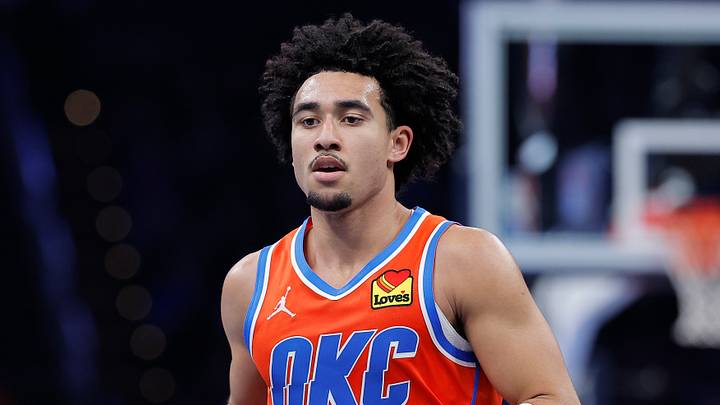
With the Oklahoma City Thunder now on the outside looking in of the play-in picture, it's undeniable that the team needs more out of its usual scorers.
Shai Gilgeous-Alexander has done everything he can since the Thunder lost three starters just a few games into the season. Since that fateful night against the Los Angeles Clippers, he's averaged 32.9 points, 3.9 rebounds, and 4.8 assists while knocking down 37.5% of his attempts from beyond the arc. If the team was in the orbit of the league's true contenders right now, those could very well be MVP-level numbers.
But the structure of this team has changed drastically since Jalen Williams, Cason Wallace, and Chet Holmgren went down. Ajay Mitchell, naturally, has stepped into a role as the secondary scorer behind GIlgeous-Alexander. But apart from that, almost none of the team's rotational contributors have succeeded in taking on the extra offensive workload that these absences require of them.
And most notable among this stretch of sub-par play has been Jared McCain's shooting slump—he's knocking down just 32.1% of his perimeter attempts on the season, and the Oklahoma City offense has suffered heavily for his lack of consistent shooting.
With McCain nearing extension-eligibility this offseason, there's reason to think that a full season of this level of performance could affect how the Thunder view his future with the organization. After all, if McCain can't be trusted to scale up his game, how could Oklahoma City even think about fitting him into their books long-term?
But the early portions of this season haven't been any sort of suitable proving ground for a player of McCain's archetype, and the Thunder have enough flexibility to wait on making a full evaluation of McCain's value moving forward.
Jared McCain is a complementary piece—and the Thunder don't have the offensive structure currently to maximize him
When the Thunder made the trade for McCain at last season's deadline, it's important to remember that they simply didn't know what they were getting. McCain had almost fallen out of the rotation with the Philadelphia 76ers after his struggles with injury and inconsistent offensive impact. That deal, in which Oklahoma City sent out a first-round selection and four second-round picks, was a swing on a guard that still had over two years of cost-effective team control on his contract. If he could push his way into the rotation last season with his perimeter shooting, that was simply a bonus.
McCain did. He not only hit his shots consistently from beyond the arc, but he found a way to quickly morph into the Thunder's swarming defensive scheme as well. By the time Oklahoma City's playoff run wrapped up, he had surpassed both Isaiah Joe and Aaron Wiggins in the Thunder's rotation.
His real value, then, was supposed to come this year—when either one or both of Wiggins and Joe were essentially guaranteed to be off the roster. It's understandably disappointing that, nearly 20 games into his season, that value hasn't shown up.
But at the end of the day, McCain is a complementary piece. He's at his best when he's able to work off of a team's primary ball-handlers, working his way through off-ball screens and finding catch-and-shoot opportunities from beyond the arc. His volume in that regard has actually gone up—he's averaging 4.6 catch-and-shoot attempts compared to the three he averaged last season with the Thunder.
But those looks aren't nearly as clean as the ones he'd be getting with Williams and Wallace in the fold. He's been forced, this season, to take on a role that's almost entirely unfamiliar to him. And with a third-year player, there's an adjustment period to be accounted for whenever that happens.
Now, it's fair to critique McCain's game based on his clear lack of self-creation and his inability to scale up his performance in the absence of the team's stars. And if those things come into play when discussing the value of his extension, that's fair as well—especially if this shooting slump extends over the duration of this season.
But part of the value of the McCain trade was that the Thunder had essentially two full seasons to evaluate him before they need to make a true decision on a potential extension. It remains highly unlikely they'll extend him ahead of his restricted free agency, meaning that Oklahoma City will (hopefully) have the entirety of 2027-28 to truly analyze McCain in the full offensive context of this team as it's been constructed.
And as long as this is a team that's still in desperate need of consistent perimeter shooting, even with its stars healthy, it's wise to take this stretch from McCain with a grain of salt when it comes to the long-term evaluation of his fit with the Thunder.
 Add us as a preferred source on Google