

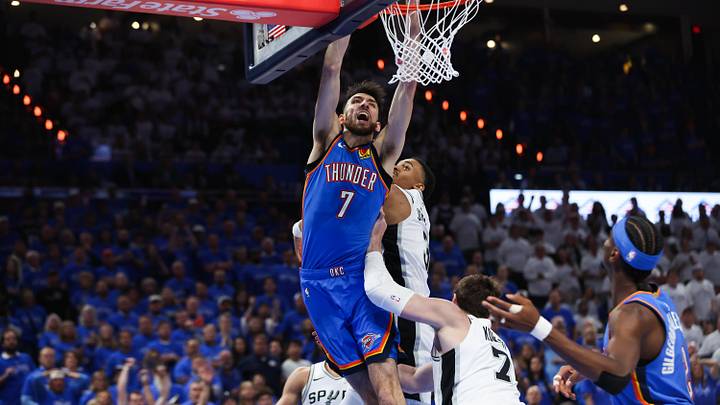
The Oklahoma City Thunder had a statement win in Game 2 against the San Antonio Spurs, largely due to the game plan against the Defensive Player of the Year, Victor Wembanyama.
Arguably, the biggest change in the entire game was OKC's mentality toward attacking Wemby.
To begin the series, there was constant hesitation and redirection with him under the rim, which made it easier for the Spurs to guard the perimeter and led to fewer looks in the paint. In Game 2, the Thunder changed this and realized that, to win, they must stick to their aggressive offensive identity.
Their relentless offense against Wemby worked, as it made him less of a roaming defender, caused him to expend more energy, and forced the entire San Antonio defense to change how they played.
Thunder willingness to drive aggressively has created simpler offense
Even though OKC actually drove to the basket four fewer times in Game 2, they did so with far greater efficiency. In Game 1, on 67 drives, they were 11-for-25 and created 31 total points. Game 2 was much different, as they went 14-for-24 on drives.
The Thunder were very creative in generating these easy opportunities, one of which was to use Isaiah Hartenstein as a battering ram. His profound strength and size helped take Wemby out of the shot entirely. So, even with Wemby on the court, OKC was finding easy ways to score.
At the forefront of the more efficient driving was Shai Gilgeous-Alexander. After an uncharacteristically poor series opener, he returned to his MVP play. To start the series, he drove 30 times, but only took nine shots and had two turnovers. In the win, he had 17 drives with nine shots mixed in with zero turnovers.
This return to his normal self as a driver created significantly more looks on mid-range and pull-up jumpers: SGA's bread and butter.
How much did this difference in Thunder drive efficiency impact Wemby?
Though the DPOY still had his typical defensive stat line, swatting four shots and grabbing 12 rebounds, his impact was still altered.
There were 29 shot attempts on Wemby, with only 11 of them falling. These are still otherworldly numbers, but this meant he was in the action more than Game 1, where they only took 22 shots on him.
In essence, in this game, the Thunder went after Wemby, instead of him meeting them. This caused him to roam less and instead only affect the ball-handler. This change created more room for cutters, as well as opening up the short-roll game for the big men.
Wemby's amount of on-ball defensive work took a toll, as he was less involved in the Spurs' offense.
The superstar was held to 21 points, with only seven shot attempts inside the arc. With him having to settle for more perimeter shots, OKC has a significantly reduced workload of forcing the big man outside the paint.
Although Victor Wembanyama will always have an alien effect on the game, the OKC Thunder's Game 2 approach to him could be the key to winning the series.
 Add us as a preferred source on Google