

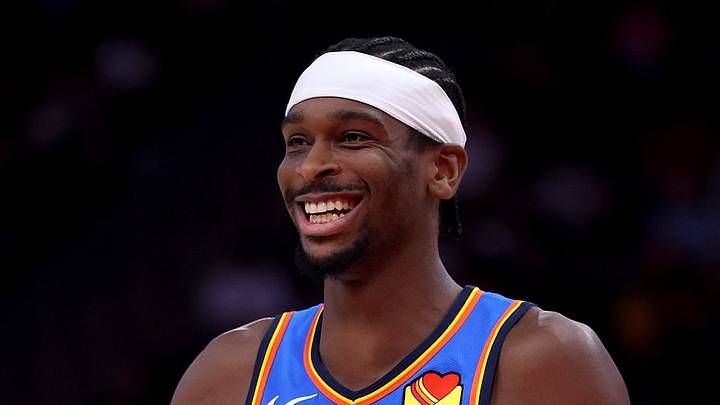
The Oklahoma City Thunder went 4-8 against the San Antonio Spurs during the 2025-26 season. It's a truth that's formed a cloud over their heads throughout the 2026 offseason, as San Antonio not only dominated the regular season head-to-head, but eliminated Oklahoma City from the playoffs. Thankfully, Shai Gilgeous-Alexander made a statement during their 2026-27 opening-night clash.
The statement was a 32-point game in a 116-104 Thunder win that acted as a powerful reminder that the reason superstars are paid what they are is because bad shots for them are often still the best option.
Efficiency is the rational goal for every team, but if games could be won with formulas and shot charts, they wouldn't need to be played. Everyone would simply make the shots they're supposed to and the outcomes would constantly align with expectations.
The reason max-level players exist in the NBA, however, is the simple fact that the great offensive minds drawing up flawless on-paper strategies are being countered by equally as brilliant defensive tacticians—and it's on the best of the best to step up when the offensive game plan falls apart.
Gilgeous-Alexander did exactly that, going off to the tune of 32 points, six rebounds, four assists, three blocks, and three steals on 13-of-27 shooting from the field. Yes, 32 points on 27 shots isn't ideal, but it was what the situation called for—and what Wembanyama was unable to provide for San Antonio.
On a night when Gilgeous-Alexander kept the shots coming even when they weren't always falling, Wembanyama went 1-of-13—and though that's uncharacteristically poor, it still sent a message.
OKC's greatest advantage: A superstar who doesn't shy away from tough shots
Though that may seem harsh on Wembanyama, he himself evaluated his poor performance by saying: "I got no reason to be hesitant, no reason to not be myself." He was speaking about not just his poor shooting, but his lack of assertiveness on offense—both in shot selection and the spots he was setting up from.
Gilgeous-Alexander, meanwhile, shot just 6-of-15 during the second half, but kept putting up shots for the simple reason that his teammates weren't finding success themselves.
OKC players other than Gilgeous-Alexander combined to shoot 13-of-34 from the field—or 38.2 percent—during the second half. Among the starters, Jalen Williams went 3-of-8, Cason Wallace was 1-of-5, Chet Holmgren shot 1-of-3, and Isaiah Hartenstein split his two attempts.
Aday Mara and Jared McCain were effective off the bench, but fellow key reserves Alex Caruso, Ajay Mitchell, and Jaylin Williams combined to shoot 1-of-8 during the second half.
Thunder know their superstar will shoot them out of a funk
With all of this established, Gilgeous-Alexander showed why the Thunder are a championship-caliber team: When all else fails, he isn't afraid to face the risk of failure. He knows what his burden is as a go-to scorer and he's happy to take criticism for inefficiency when an inefficient superstar is simply a better option than a struggling supporting cast.
Along those same lines, Gilgeous-Alexander's six combined blocks and steals showed effort and tenacity on defense that supported his on-ball specialist teammates.
Putting the numbers aside, what the clash between Oklahoma City and San Antonio ultimately came down to was which superstar stepped up late. While Gilgeous-Alexander shooting 6-of-15 during the second half wasn't statistically ideal, it was far better than Wembanyama refusing to shoot a single shot during the fourth quarter.
The rivalry won't be decided on opening night, but the difference in mentality among the superstars is still a primary reason to believe the Thunder haven't been officially surpassed yet.
 Add us as a preferred source on Google