

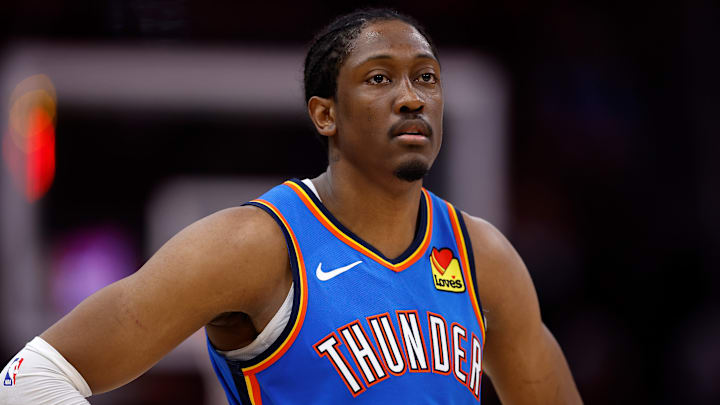
Just 10 short days ago, the Oklahoma City Thunder held a league record-tying 24-1 record. Now, they've lost two of their last three games to San Antonio and Minnesota, and there's a few adjustments to be made. Since Jalen Williams returned from injury a little over three weeks ago, re-incorporating him into the lineup hasn't been as simple a change as one might have thought.
It's incredibly ironic, because the Thunder's superb roster depth is one of their greatest advantages. They had been able to continue steamrolling opponents without one of their top three players, but now that he's back in the fold, they're still in something of an adjustment period.
This has shown up most clearly in the flow of Oklahoma City’s offense. Before Williams returned, the Thunder were playing with extreme clarity in their roles. The ball moved quickly and the decision-making hierarchy was clean. Since his return, there have been moments where possessions stall as players recalibrate who should be initiating or attacking. That kind of hesitation takes a minute to get ironed out.
Jalen Williams' return will require more adjustment
Williams himself deserves some grace in this process. He missed a good bit of time, and rhythm doesn't just reappear overnight, especially for a player whose game relies heavily on timing and reads off the dribble. He has looked a half-step slower defensively at times and has not consistently punished mismatches the way fans are used to seeing. None of that suggests long-term concern, but it does explain why the Thunder haven't looked quite as sharp recently.
Another subtle issue has been lineup balance. The Thunder had settled into combinations that maximized spacing and defensive communication while Williams was out. Bringing him back has forced Mark Daigneault to reshuffle minutes and experiment again, particularly with closing lineups. The experimentation is necessary, but it also comes with short-term costs, especially against disciplined teams like San Antonio and Minnesota that are eager to exploit any confusion.
The encouraging part is that these are problems of abundance, not deficiency. Oklahoma City is not struggling because it lacks talent or depth. It's struggling because it has too many high-level options that need to be synchronized again. That's a far better issue to solve in December than in April.
If anything, this stretch should serve as a reminder that dominance is rarely linear. The Thunder are still one of the league’s best teams, but even elite groups need recalibration when key pieces return. Once Williams fully settles back into his role and the rotations stabilize, this brief turbulence will likely look like a footnote when the season is done.
 Add us as a preferred source on Google