

The 2026 Oklahoma City Thunder are hoping to become the first team to repeat as NBA champions since the 2018 Golden State Warriors. For that matter, they're hoping to become the first franchise to reach the NBA Finals in consecutive seasons since the 2019 Warriors.
With a tall task ahead of them and a mountain of injuries that created a unique path to repeating as NBA champions, the Thunder employed a polarizing strategy: Sacrificing their own stability.
It's an approach that yielded mixed reviews from fans and analysts who questioned why the rotation was so consistently in flux. Injuries played a part, of course, but it almost seemed deliberate in terms of how Oklahoma City so casually flipped its own strategy on its head.
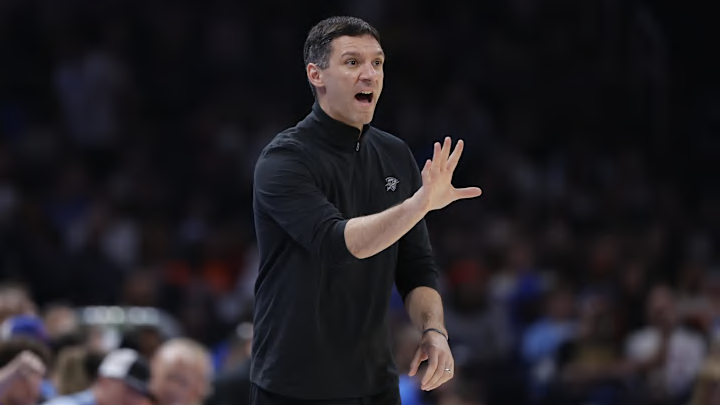
Thunder head coach Mark Daigneault confirmed it was, in fact, intentional when he stated that he never actually wanted to achieve rotational stability during the regular season.
a lot of mnba fans media and franchise cheerleaders get into a place where they whine about teams not playing their best players for 80 games
— Law Murray 🪺 (@LawMurrayTheNU) April 8, 2026
And here's Mark Daigneault saying "We're actually not a team that wants to find rotational stability in the regular season"
a message! pic.twitter.com/ZHkTF8rglb
It's an admittedly bold strategy, but preparing Oklahoma City for the unpredictability of the playoffs by keeping them on their toes could create the cohesion they need—or break the team apart.
Mark Daigneault purposely avoided regular season "rotational stability"
Stability was admittedly tough to come by for a team that played 49 games without All-NBA wing Jalen Williams and 35 down starting center Isaiah Hartenstein. It also lost breakout reserve Ajay Mitchell for 25 games, with defensive ace Alex Caruso missing 26 himself.
The Thunder also completed a mid-season trade for a new impact player in Jared McCain, who has thus far appeared in a grand total of 30 games for the defending champions.
In saying that, Oklahoma City could've resorted to a general rotation to help it navigate such a difficult roster situation. Instead, it continuously changed roles and usages in order to keep players on their toes and help them develop skills they may not have previously wielded.
That materialized with 14 different players appearing in the starting lineup and a number of contributors experiencing surges in production along the way.
Will Thunder's intentional instability create adaptability or distortion?
The question come the playoffs, however, will be whether or not the Thunder are prepared for a unique title defense. They're effectively looking to secure a second straight championship despite not having their core in place for even half of the season.
To make matters even more difficult, the Western Conference has a brand new top on-paper threat, as the San Antonio Spurs went from 34 wins in 2024-25 to 62 in 2025-26.
For as fair as the concerns and general skepticism may be, the Thunder are still an experienced side that has been through the ups and downs of a championship journey together. There are fresh faces and new challenges, but the core in place still remains generally the same.
The question is: Did Daigneault's approach prevent stagnation and complacency? Or did it deter the Thunder from developing the chemistry they need to win a second straight title?
 Add us as a preferred source on Google